
Rock Island Directory Collections
The Rock Island city directory shelf is spread across local print, microfilm, licensed databases, and special collections. The Rock Island Public Library genealogy and local history collection is the main starting point. Its page reports city directories from 1855 to the present, but it does not publish a complete volume-by-volume catalog online. Verify an exact year with library staff before planning a visit.
| Collection | Years or span | Where held | Access route |
|---|---|---|---|
| Rock Island city directories | Library reports 1855 to present | RIPL Historical Room | Print, microfilm, catalog check, and staff help |
| Rock Island and Moline digitized runs | 1882–1885, 1885–1888, 1888–1891, 1891–1892 | Ancestry collection 4684 | Subscription or Ancestry Library Edition |
| Rock Island and Moline directories and phone books | State guide says directories from 1850 to current; phone books from 1965 to current | Illinois library holdings route | Confirm the specific volume and keeper |
| Local maps, directory data, and publications | Maps and directories 1837–1994/undated; publications 1884–1996 | Augustana Special Collections | Online finding aid and repository contact |
| Rock Island Argus | RIPL reports 1866 to present | Library microfilm and local archives | On-site, licensed database, or digitized newspaper search |
| Sanborn map set | January 1892, 29 sheets | Library of Congress | Free online images |
No verified source gave one final printed year for every series. Nor was a full local Sanborn year list found. Those are catalog questions, not facts to guess. The city directory collection is strongest when the exact title page and publication year are recorded with each entry.
The library's collection page appears below as the official entry to its genealogy and historical resources.

The captured page anchors the city directory search at the local keeper, where print and licensed sources can fill gaps in open web access.
Rock Island Directory Runs, 1882–1892
The precisely cataloged Rock Island and Moline directory collection contains more than 40,100 people, principally household heads. Four publication runs are known. Holland Publishing Co. covers 1882–1885 in an 1885 volume and 1885–1888 in an 1888 volume. Frank Orff Publishing Co. covers 1888–1891 in the 1891 issue. H.N. Stone and Co. covers 1891–1892 in the 1892 issue.
Those ranges are not annual editions. A person can appear once within a multi-year run, and the indexed record may omit other household members. The database can connect entries to census material, but original page images require a subscription, login, or library edition. Record the publisher and range exactly. A date attached to the digital database is not necessarily the date the information was gathered.
| 1882–1885 | Moline and Rock Island City Directory, Holland Publishing Co., issued 1885 |
|---|---|
| 1885–1888 | Holland Publishing Co., issued 1888 |
| 1888–1891 | Frank Orff Publishing Co., issued 1891 |
| 1891–1892 | H.N. Stone and Co., issued 1892 |
Rock Island Directory Library Routes
RIPL brings several companion sources into one research route: city directories, Argus microfilm, NewsBank access, Ancestry Library Edition, HeritageQuest, plat maps, postcards, photographs, yearbooks, and a limited obituary index. HeritageQuest can be used from home with a Rock Island Library card. Licensed Ancestry access may require use in the library. Ask staff to confirm the directory year and format before relying on the broad 1855-present statement.
The Historical Room also helps when web indexing fails. Search a surname, then an address, neighborhood, school, church, or organization. A limited obituary index is only a first pass. If its date range does not reach the event, move to newspaper databases, the County Clerk death index, or an archive inquiry. Each access channel covers a different gap.
Note: Copy the directory's title page and abbreviation key before copying an entry, because both define how names and address marks should be read.
Read a Rock Island Directory Entry
A verified city directory schema includes the indexed name, street address where present, a household marker, historical occupation or employer text, publication range, and access to the original image. No named sample page was opened during research, so a person, address, spouse, or job should not be invented as an illustration. Read the original line and its key.
| Indexed name | Usually a person entry and principally a household head in the digitized collection. |
|---|---|
| Street address | House number and street when printed; the starting key for reverse research. |
| Household marker | h means home, r residence, and b boarder in the verified key. |
| Historical work text | Occupation or employer wording may distinguish people with the same name. |
| Publication | The title, publisher, and multi-year range that give the entry its date context. |
| Page image | The source to inspect when an index transcription or spelling looks doubtful. |
- Criss-cross directory
- An address-order section that reverses the usual name search and groups entries by street and number.
- Householder index
- A list focused on named household heads, not a census of every person at the address.
- Abbreviation key
- The volume's own explanation of short forms. Save it because conventions can vary by publisher and year.
An entry is evidence for its publication period. It does not establish current residence. Compare initials, cross streets, nearby entries, and the original scan before concluding that two similar names are the same person.
Reverse Rock Island Directory Searches
Later address-order sections let a reader move from a Rock Island street to a listed occupant. Begin with the exact number, then search the street name without its suffix and inspect nearby numbers. Record every h, r, or b. Those marks can keep a boarding entry from being mistaken for ownership.
Street numbers may change, and no verified citywide renumbering year was located. Bridge a mismatch with intersecting streets, subdivision or ward wording, nearby institutions, a deed legal description, and a map. For records from 1835–1841, try Stephenson as well as Rock Island. That earlier place name is a search key, not just local color.
The modern parcel workflow is covered separately in the Rock Island street directory. A historical reverse search should stay tied to the year printed in the book.
Rock Island Directory Newspaper Checks
The Rock Island County Historical Society newspaper search accepts keywords, a phrase option for people, places, and events, plus country, state, city, title, and date controls. OCR means optical character recognition, the machine-read text pulled from a scan. It can misread type, so inspect the newspaper image after a text hit.
Pair a surname with a street, church, school, neighborhood, or civic group. The Rock Island Argus run reported by RIPL reaches from 1866 to the present, while current Dispatch-Argus access is described through NewsBank. Exact title-by-title dates for the Historical Society archive were not confirmed. An obituary can name relatives and former places, but it remains a newspaper account rather than a legal certificate.
Rock Island Directory Sources at Augustana
Augustana Special Collections' local history finding aid covers material dated 1713–2017 or undated, including maps and directory information from 1837–1994 or undated and Rock Island publications from 1884–1996. Repository searching can be narrowed by term, operator, record type, field, and year. Staff contact is another route when the finding aid describes a box but does not digitize its contents.
The college's Observer newspaper and Rockety-I yearbooks add names, classes, groups, and dated campus context. Its Upper Mississippi Valley Digital Image Archive contains about 60,000 local images. These are companion collections, not substitutes for a city directory entry. Use them to distinguish people, connect an institution, or see how a place looked during the same period.
The captured Augustana finding aid shows the repository description and access point for those local-history materials.
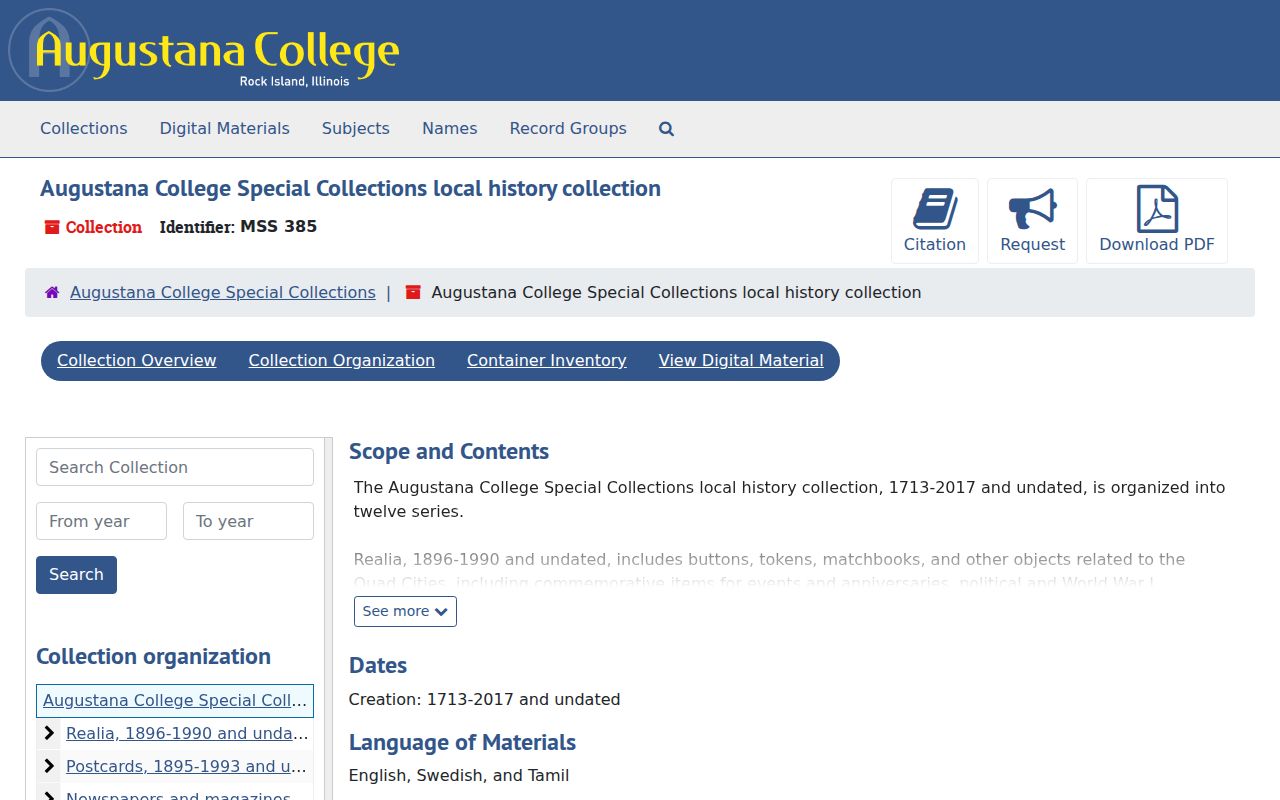
The finding aid helps a researcher request maps, directories, publications, and subject files that do not appear as open full-text images.
Map a Rock Island Directory Year
The Library of Congress Rock Island Sanborn set contains 29 sheets dated January 1892. The map can show street names, lot outlines, building footprints, outbuildings, businesses, and fire-construction context. It does not name every occupant. Place a directory address on the correct sheet, compare the structure and nearby streets, then test the property in a deed book or later map.
This method is especially useful when the address wording does not fit the modern grid. Illinois digital Sanborn resources span a broad 1867–1970 period statewide, but the complete Rock Island year list was not verified. Cite only the sheet and year actually viewed. Local historic-house PDFs confirm that Rock Island research is distributed across deeds, Stone directories, Sanborn sheets, and neighborhood sources rather than one official house-history service.
Trace Family in Rock Island Directories
City directories work best as a sequence. A volume before or after a federal census can narrow the household to the correct street, while the census adds household composition and ward context. Public federal census images follow the 72-year release rule and are available through library Ancestry or HeritageQuest access.
- Find the earliest likely name or address entry. Save the title, range, publisher, page, spelling, initials, and printed abbreviations.
- Check the next earlier and later available volumes. Mark moves, new initials, widow notation when actually printed, and gaps without assuming what caused them.
- Reverse the search by street when the volume supports it. Compare nearby numbers and cross streets to guard against an address change.
- Pair a directory near a census year with the released census image. Use the census to test household members rather than reading them into a head-only entry.
- Follow the last appearance into the Argus, obituary index, death index, cemetery, deed, or probate route as the evidence calls for it.
A person who vanishes from a Rock Island city directory may have moved, died, been omitted, changed name, or appeared under initials. Only a later source can explain the gap. This patient sequence can reconnect a historical household or classmate without turning a current address into a public household list.
Note: Treat every directory year as a dated snapshot, then use census, newspaper, deed, or vital evidence to explain changes between volumes.